
MBBS Visa Process in Malaysia: Step-by-Step EMGS Guide
Learn the MBBS visa process in Malaysia: offer letter, EMGS application, medical check, eVAL and student pass, with timelines for Bangladeshi students.
MBBS Visa Process in Malaysia: A Step-by-Step EMGS Guide for Bangladeshi Students
The MBBS visa process in Malaysia is the set of steps an international medical student completes to get permission to enter Malaysia and study MBBS there. For Bangladeshi students, every step runs through EMGS, the Education Malaysia Global Services body that screens each international student application.
The route is short to describe and easy to get wrong in practice. It starts with an offer letter from the university, then moves to an online EMGS application, a medical check, eVAL approval and a student pass collected on arrival. This guide explains each stage, how long it takes, what must be ready before it begins and where families lose time.
Planning your MBBS in Malaysia? Book a free counselling session and a certified counsellor will map your visa timeline against your intake.
Key Takeaways
- Every MBBS student visa for Malaysia goes through EMGS, after the university issues an offer letter.
- The route has five stages: offer letter, EMGS application, medical check, eVAL approval and student pass.
- EMGS approval usually takes three to eight weeks from the day a complete application is submitted.
- Start four to six months before the intake you want, so visa processing does not eat into your start date.
- Check recognition first. For medical programmes, that means the BMDC list, before the visa file begins.
What Is the Student Visa for MBBS in Malaysia?
The student visa for MBBS in Malaysia is the permission, issued through EMGS, that lets an international student enter the country and study at a Malaysian university. In practice it is not one document. It is a short chain: an approval stage before you travel, and a student pass that is endorsed once you arrive.
MBBS students follow the same route as other international students, but the stakes feel higher because the programme is long. On uniThink’s page for MBBS and MD in Malaysia, the course runs five years and is described as BMDC recognised. A visa delay at the start therefore affects a long academic plan, not just one semester.
Most students enter after HSC or A-Level, or with a diploma that carries advanced standing. A foundation year bridges the gap for students whose qualification sits outside the standard route. Whichever entry point you use, the visa file follows the university’s offer letter, never the other way round.
Universities such as Monash University Malaysia and University of Malaya appear on uniThink’s Malaysia page with MBBS among their programmes. Once a university accepts you, the visa work begins. You can read the programme details on the page for MBBS in Malaysia.
What Is EMGS and Why Does Every Applicant Go Through It?
EMGS stands for Education Malaysia Global Services. It is the body that screens every international student application for Malaysia, which makes it the centre of the MBBS visa process. No Bangladeshi student skips it, whether the course is medicine, engineering or business.
The university does not issue the visa on its own. After you accept an offer letter, the university submits the EMGS application, and EMGS decides. At uniThink, the counsellor prepares the file with you, submits it through the EMGS portal and tracks it, so you hear the moment the eVAL is issued.
EMGS describes itself as a company under the purview of the Ministry of Higher Education Malaysia, and its own website explains the route in its words. For the official view of the process, read the EMGS student visa overview on the Education Malaysia website alongside this guide.
Understanding EMGS early removes a common worry. Families often ask which office they should visit in Dhaka. The application is online, and the file is built from documents and a medical check, not from queues at a counter.
How Does the MBBS Visa Process Work, Stage by Stage?
The MBBS visa route has five stages, and each one depends on the one before it. Skipping ahead or working out of order is how files get stuck.
Stage one is the offer letter. The Malaysian university issues it once your application is accepted. Without it, the visa file cannot start.
Stage two is the EMGS application. It is submitted online through the EMGS portal, with the documents prepared and checked before submission.
Stage three is the medical check. It is done with an approved panel physician in Bangladesh.
Stage four is eVAL approval. EMGS reviews the complete file and issues the approval. Processing typically takes three to eight weeks.
Stage five is the student pass. You collect it on arrival, and it is endorsed at the university.
The five stages look simple on paper, but the timing between them is where students lose weeks. The offer letter sets the clock, the EMGS file needs to be complete before it counts, and the medical check must be ready before approval. Treat the stages as a chain, and plan the whole chain from the intake date backwards.
MBBS Visa Stages at a Glance
The table below puts the full route on one screen. Use it as a checklist while you work with your counsellor, and tick each row only when the stage is truly finished, not when it is merely started.
| Stage | What happens | Who is involved |
|---|---|---|
| 1. Offer letter | The university accepts your application and issues the letter | Malaysian university |
| 2. EMGS application | The file is submitted online through the EMGS portal | University, EMGS, your counsellor |
| 3. Medical check | Health check with an approved panel physician in Bangladesh | You and the panel physician |
| 4. eVAL approval | EMGS reviews the file; typically three to eight weeks | EMGS |
| 5. Student pass | Collected on arrival and endorsed at the university | You and the university |
Notice that the table has no stage called “pay an agent to guess the result.” Every stage is a clear action with a clear owner. When someone tells you that a stage can be skipped, ask them to show it in writing. A visa route that depends on shortcuts is not a route you want your five-year medical plan to rest on.
What Must Be Ready Before the EMGS Application Starts?
Three things need to be settled before the EMGS file begins: a confirmed offer, a qualification that fits the entry route, and a recognised university.
First, the offer letter. EMGS processing starts only after the Malaysian university has accepted you, so the visa timeline begins on that day, not on the day you first enquire.
Second, your entry qualification. The foundation route starts after SSC or O-Level with five subjects, and bachelor entry starts after HSC, A-Level or a recognised diploma. Where a university asks for IELTS, uniThink’s entry table lists IELTS 5.0 or equivalent for foundation entry and 6.0 or equivalent for bachelor entry. Many universities also accept an English-medium academic background or their own placement test instead.
Third, recognition. A visa for a programme that your home regulator will not accept helps nobody. Counsellors check the current list for your field before the university goes on your shortlist.
If you are choosing between entry routes, the page on MBBS and MD programmes in Malaysia lists the admission table, the application route and the factors that change your total cost. Bring your transcripts to the counselling session so the counsellor can match your grades to the right entry level.
Why Does the Medical Check Matter Before Approval?
The medical check is stage three of the route, and it sits between the EMGS application and eVAL approval. In uniThink’s route, it is done with an approved panel physician in Bangladesh. That wording matters, because the physician must be an approved one for the check to count.
Many families treat the medical check as a small formality. It is better to treat it as a scheduled task with its own deadline, since a late report can hold up an otherwise complete file.
Book the appointment as soon as the counsellor confirms the EMGS submission date. Keep the report safe, in both paper and digital copies, and give the counsellor a clean scan so the file is complete when it is reviewed.
For MBBS applicants the check also carries a quiet advantage. A medical degree is a long, demanding course, and sorting out your health paperwork early removes one source of stress before you travel.
Avoid asking a friend or a nearby clinic to do the check if they are not an approved panel physician. A report from the wrong source costs you time and a second appointment. If you are unsure, ask your counsellor for the approved option before you pay anything.
What Is an eVAL and What Happens When It Arrives?
The eVAL is the approval EMGS issues when your application clears. In uniThink’s route, it is stage four, and it is the green light that moves you from paperwork to travel planning. Until it arrives, the visa file is still open.
Processing for the eVAL typically takes three to eight weeks from the day a complete application is submitted. The word “complete” does real work in that sentence. A file with missing items does not start the clock in the way families expect.
At uniThink, the counsellor tracks the file and tells you the moment the eVAL is issued. That matters because the next steps move quickly. You can plan your pre-departure briefing, coordinate airport pickup and prepare for your first weeks on campus.
The eVAL also changes how you plan money. Many families wait for approval before they book flights and housing. That is a sensible order, because the approval is what confirms your start date.
Keep a copy of the eVAL with your passport documents. You will use it as part of your travel and arrival paperwork, and a lost copy creates avoidable stress at the airport.
How Long Does MBBS Visa Processing Take in Malaysia?
EMGS approval usually takes three to eight weeks from the day a complete application is submitted. That is the processing window, but it is not the whole timeline.
The full timeline includes the offer letter, the document preparation, the medical check and the wait for approval. This is why uniThink advises students to start four to six months before the intake they want. Visa processing alone can take three to eight weeks, so an early start is what protects your intake.
One student placed in Malaysia through uniThink shared that EMGS took seven weeks and that the file was tracked the whole way. That sits comfortably inside the range, and it shows why a buffer matters. A student who plans for the shortest case can miss the intake. A student who plans for the longest case arrives on time.
Count backwards from your intake date. Allow time for the approval, then for the medical check, then for the EMGS submission, then for the offer letter. Write the dates on one sheet and share it with your parents.
For a wider look at the Malaysian route, including universities and the full study plan, read this guide on EMGS and the Malaysia student visa.
When Do You Receive the Student Pass in Malaysia?
The student pass is stage five, and it comes last. In uniThink’s route, you collect it on arrival, and it is endorsed at the university. This is why the earlier approval matters so much: the pass follows the eVAL, never the other way round.
Think of the student pass as the document that turns your arrival into legal study. The eVAL gets you ready to travel, and the pass confirms your place as an international student once you are in Malaysia.
Students often ask what to carry. Keep your passport, offer letter and eVAL together in your hand baggage so you can show them when asked. Keep digital copies on your phone and email them to a parent as a backup.
On arrival, your university guides the endorsement step. Ask the university’s international office about the date and the place, and write it down before you fly.
The first weeks matter. uniThink’s support continues through the first weeks on campus, so you are not alone with the paperwork when you land. If something looks different from what you expected, message your counsellor the same day, since small questions are easier to fix early.
Does BMDC Recognition Come Before or After the Visa?
Recognition comes first. A visa lets you study, but the Bangladesh Medical and Dental Council (BMDC) decides whether your degree can be registered in Bangladesh. The two decisions are separate, and the order matters.
BMDC publishes a list of approved foreign medical schools, and a degree from a university outside that list cannot be registered in Bangladesh. That is why uniThink checks the current recognition list for every institution before it goes on your shortlist. For medical programmes, that check means BMDC.
Students who start the visa file before checking recognition risk a painful situation. The visa can be approved, the fees paid and the course started, and the degree still cannot be used at home.
Check the list in writing, and keep the proof with your documents. Ask any agency to show you the university on the current list. If they cannot, walk away.
The same principle is explained in this guide on how BMDC recognition works for medical degrees. It uses China as the example, but the habit applies to Malaysia too. Verify first, apply second, and file the visa third.
What Slows Down an MBBS Visa File?
Most delays come from a handful of repeated causes, and nearly all of them are avoidable. Knowing them early is the cheapest protection you have.
Starting late. The eVAL needs three to eight weeks, and the other stages need time too. A family that starts two months before the intake is already behind.
Submitting an incomplete file. The processing window counts from a complete application. Missing items push the real start date later than you think.
Choosing the university before checking recognition. If the university fails the BMDC check, the visa work starts again for a different one.
Using an unapproved panel physician. The medical check must be done with an approved physician, or the report may not count.
Losing track of the file. A file nobody tracks can sit unnoticed. uniThink tracks every file through to approval.
A rejected visa file is a familiar story among students who took advice from someone untrained. The fix is not luck. It is a clear order, a complete file and a counsellor who watches the status until the eVAL arrives.
Which Costs Surround the Visa Stage of MBBS in Malaysia?
The visa is one line in a longer budget. Families who focus on the visa alone often miss the rest of the picture, so it helps to list every item before you commit.
According to uniThink’s guidance, the full cost includes tuition, accommodation, food, transport, insurance and the one-off costs at the start. The visa stage sits inside that list, and some costs appear only in the first weeks after arrival.
The practical rule is to ask for a written cost breakdown before you pay anything. On uniThink’s Malaysia page, the exact figure depends on the university, the city and your entry level, and the counsellors give a written breakdown first. A student’s review on the site says no hidden fees turned up later, and the figure given at the start is what the family paid.
Also remember that the factors behind your total change with the route. A public university and a private one price differently, a foundation entry adds a year before the degree, and the exchange rate moves between instalments.
Keep one sheet for the whole plan. Add the offer, the visa stage, the first-year costs and the later years, then review it with your parents before you accept an offer.
How Does uniThink Support the Visa File From Offer to Arrival?
uniThink handles the visa as one part of a five-step service: free counselling, university selection, application and offer, visa processing, and departure and arrival. The same counsellor stays with you from the first conversation to your first weeks on campus.
In the visa stage, EMGS paperwork is prepared, submitted and tracked right through to approval. The counsellors are certified through the ICEF Agent Training Course and trained through the British Council UK Agent and Counsellor Training Course, and the counselling itself is free. uniThink is paid by partner universities after a student enrols, not by the student.
After approval, the support continues. Students get a pre-departure briefing, airport pickup coordination and support through the first weeks on campus.
Counselling happens in person at the Green Road office in Dhaka, and online by video call or WhatsApp for students elsewhere in Bangladesh. The service and the price are the same in both cases: free.
If you want the wider picture before you focus on the visa, the guide to studying in Malaysia from Bangladesh covers the universities, entry routes and the complete visa route in one place.
Get Your MBBS Visa Timeline Mapped Before You Apply
A medical degree is a five-year plan, and the visa is the gate at the start. A clear route, a complete file and a recognised university protect the years that follow.
A certified counsellor can check your results, explain the five stages and count backwards from your intake date, so you know when each step must happen. You also get a clear picture of total cost and visa timeline before you commit to anything.
The session is one-on-one and free, and you can bring your parents so everyone hears the same answers. Bring your transcripts and your questions, and leave with a clear next step.
Book your free counselling session or message uniThink on WhatsApp.
Office: Suite 106-107, 1st Floor, R H Home Centre, 74/B/1 Green Road, Dhaka 1215. Open Monday to Saturday, 10:00 to 19:00. Phone: +880 1988-656677.
Frequently Asked Questions About the MBBS Visa Process in Malaysia
Is EMGS compulsory for an MBBS student visa in Malaysia?
Yes. All international students, including MBBS students, must go through EMGS for student visa processing. After you accept an offer, the university submits your application through EMGS.
How long does the EMGS visa take for MBBS students?
EMGS approval usually takes 3–8 weeks after a complete application is submitted. uniThink recommends starting the process 4–6 months before your intended intake to allow time for possible delays.
Do I need a medical check for the Malaysia student visa?
Yes. A medical check is required during the visa process. You should use an approved panel physician in Bangladesh and follow your counsellor’s guidance to avoid delays.
Can I apply for the MBBS student visa myself?
The university submits the EMGS application online after you accept an offer. uniThink helps you prepare documents, manage the application and track its progress for free.
What happens after the eVAL is issued?
After your eVAL is issued, you can prepare for your journey to Malaysia. uniThink provides pre-departure guidance and airport pickup coordination, while your university guides you through the student pass endorsement process.
Does uniThink charge for MBBS visa support?
No. uniThink offers counselling, university selection, application assistance and visa guidance for free. Partner universities pay uniThink a commission after a student enrols.
Keep reading
- Visa & Immigration
MBBS Student Life & Living Costs in Malaysia (2027 Budget)
Plan MBBS student life in Malaysia: monthly living costs of RM1,200–2,500, city comparisons, visa renewals and part-time work rules for Bangladeshi families.
Read full guide: MBBS Student Life & Living Costs in Malaysia (2027 Budget)  Visa & Immigration
MBBS Eligibility in Malaysia for Bangladeshi Students (2027)
Check MBBS eligibility in Malaysia after HSC: required science subjects, grades, IELTS, documents and BMDC checks Bangladeshi students need before applying.
Read full guide: MBBS Eligibility in Malaysia for Bangladeshi Students (2027)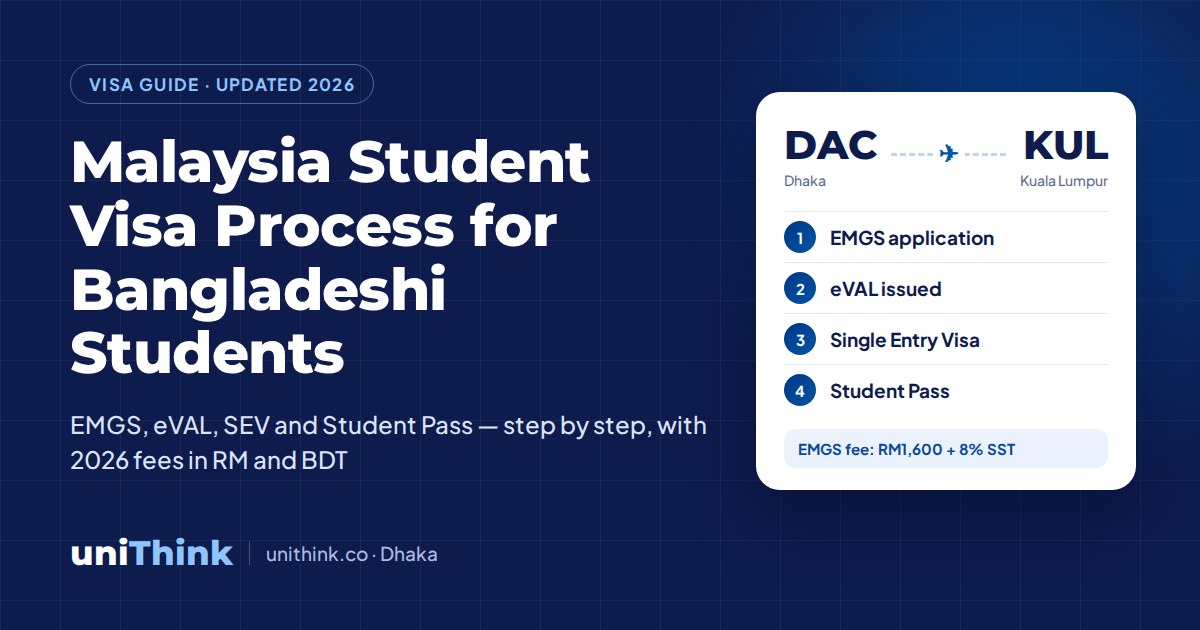 Visa & Immigration
Malaysia Student Visa Process for Bangladeshi Students
Every step of the Malaysia student visa process for Bangladeshi students — EMGS, eVAL, Single Entry Visa, Student Pass — with 2026 fees in RM and BDT.
Read full guide: Malaysia Student Visa Process for Bangladeshi Students